How SEO Can Benefit Users in a Variety of Meaningful Ways

SEO isn’t just for businesses—it greatly improves the user experience too. It helps people find relevant, high-quality information quickly, enhances website speed, usability, and accessibility, and makes online browsing safer and more trustworthy. SEO also supports mobile-friendly design, local search results, and ensures sites are inclusive for all users. When SEO is done well, everyone benefits—not just the website owner.

SEO Can Benefit Users in a Variety of Ways

Search Engine Optimisation (SEO) is often viewed through a business-first lens—an essential tool to improve rankings, gain traffic, and ultimately increase conversions. But while it’s true that businesses reap substantial rewards from effective SEO, it's equally important to recognise how much users benefit from these practices as well. In fact, when SEO is done properly, it enhances nearly every aspect of the online experience for the end user.

From faster access to reliable information to improved website functionality and accessibility, SEO plays a crucial role in shaping how people interact with content online. This article explores the many ways SEO benefits users and contributes to a better, more efficient, and more inclusive digital world.


1. Faster Access to Relevant Information

One of the most immediate and noticeable benefits SEO offers users is the ability to find what they’re looking for more quickly and efficiently. Think about your own behaviour when you use a search engine like Google. You likely type in a query and click on one of the first few results. If those top results are well-optimised, they’ll deliver exactly what you need with minimal friction.

SEO helps ensure this happens by aligning website content with user intent. This involves:

  • Keyword research and implementation – ensuring content is created using the terms and phrases people are actually searching for.

  • Optimised meta titles and descriptions – giving users a clear idea of what to expect before they click.

  • Structured content – using headings, bullet points, and concise language to present information clearly.

The result? Users get answers quickly and clearly, without wasting time on irrelevant or confusing pages.


2. Better User Experience (UX)

A major component of modern SEO involves technical and on-page elements that directly enhance user experience. Google and other search engines have evolved to prioritise websites that offer a seamless, high-quality experience. This has pushed businesses and site owners to make continuous improvements that directly benefit users. Some of these improvements include:

  • Faster loading times – Pages that load within two seconds or less retain users far better than slow ones. SEO audits often reveal performance bottlenecks that, once resolved, make websites faster and more responsive.

  • Mobile-friendly design – With mobile searches now accounting for more than half of all global traffic, mobile optimisation is no longer optional. SEO encourages responsive design, so users on phones and tablets have just as good an experience as those on desktops.

  • Clean navigation and structure – A well-structured website makes it easy for users to find what they need. Breadcrumbs, internal linking, and clear menus all contribute to better UX—principles baked into good SEO practice.

SEO-driven UX improvements don’t just serve search engines; they directly benefit people. A site that loads fast, looks good on any device, and is easy to navigate will always be more enjoyable and trustworthy for users.


3. Increased Credibility and Trust

Users are naturally cautious when navigating the web, especially when seeking information, buying a product, or signing up for a service. SEO contributes significantly to establishing credibility and trust, making users feel more comfortable engaging with a site.

Key SEO factors that influence trust include:

  • High-quality, authoritative content – Google rewards pages that demonstrate expertise, authoritativeness, and trustworthiness (known as E-A-T). For users, this means they’re more likely to land on content that’s well-written, factually accurate, and valuable.

  • Secure websites (HTTPS) – SEO best practices include using secure encryption, which users can recognise via the padlock icon in the browser. This reassures them that their data is safe.

  • Positive user signals – Metrics like low bounce rates and high time-on-page tell search engines that a site is satisfying its visitors. As a result, trustworthy sites tend to rise in the rankings, increasing the chances that users find reliable sources first.

Over time, well-optimised sites develop a reputation for quality. For the user, this means they’re more likely to find accurate information and have a safe, enjoyable experience.


4. More Inclusive and Accessible Websites

SEO and accessibility go hand in hand. Many on-page SEO techniques, such as writing descriptive alt text for images or using semantic HTML, also improve accessibility for users with disabilities.

Some SEO actions that benefit inclusivity include:

  • Alt text for screen readers – Helps visually impaired users understand images.

  • Descriptive link text – Improves navigation for those using assistive technology.

  • Proper heading hierarchy – Makes it easier for screen readers and voice-controlled browsers to interpret and present content.

  • Mobile and keyboard navigation – Benefits those who can't use a mouse or rely on keyboard shortcuts.

When a website is made more accessible for people with different needs, it also becomes better for all users. For instance, clear navigation and readable fonts help everyone, not just those with impairments. SEO encourages site owners to think more inclusively, leading to a better experience across the board.


5. Personalised, Local, and Useful Results

Local SEO is a subset of search engine optimisation that focuses on helping users find relevant businesses and services in their area. Whether someone is searching for a coffee shop, electrician, or yoga class, SEO helps surface the most relevant local results quickly.

From a user perspective, this provides:

  • Accurate local information (hours, contact details, directions)

  • User-generated content like reviews and ratings

  • Photos and service menus that help people make informed decisions

With Google Maps and the local pack displaying this info prominently, users can find nearby options within seconds—often without even visiting a website. Behind the scenes, it’s all driven by local SEO best practices.


6. Enhanced Content Discoverability and Variety

Users benefit from SEO in another significant way: discoverability of diverse and useful content. SEO doesn't just elevate major brands; it also allows niche websites, independent creators, and small businesses to compete—often by producing high-quality content that targets specific user needs.

This levels the playing field and means users have access to:

  • In-depth blog posts and guides

  • Niche products or services

  • Independent voices and unique perspectives

As a result, users are less reliant on the same handful of mainstream sites and more likely to find truly useful and personalised content.


7. Reduced Frustration and Information Overload

Poorly optimised websites can be frustrating. Think of pop-ups that cover the screen, articles that take forever to load, or vague page titles that lead you nowhere. SEO aims to reduce these pain points by encouraging clear, structured, and user-focused design.

With good SEO practices, users avoid:

  • Clickbait titles with misleading content

  • Dead links or 404 errors

  • Pages overloaded with ads or broken elements

Instead, they get a cleaner, more streamlined experience, making web browsing faster and less stressful.


Conclusion: Everyone Wins With SEO

While SEO is often talked about in the context of marketing, traffic, and visibility, its benefits reach far beyond the business world. For users, SEO creates a better web—one that is faster, safer, easier to use, more accessible, and more trustworthy.

At its best, SEO aligns what users want with what websites provide. It removes obstacles and adds clarity. It connects people to meaningful content, whether they're shopping, learning, researching, or simply browsing for pleasure.

In short, SEO is not just about algorithms or search rankings—it’s about building a better experience for people.
ElevenLabs Review for Content Creators: AI Voiceovers That Actually Sound Human

AI voice technology has improved dramatically over the last few years. What once sounded robotic and unnatural has evolved into something surprisingly realistic, useful, and in many cases almost indistinguishable from genuine human narration.

One platform leading that shift is ElevenLabs.

For YouTubers, podcasters, bloggers, educators, filmmakers, and online creators, ElevenLabs has quickly become one of the most talked-about AI tools available today. Its realistic text-to-speech engine, voice cloning system, and multilingual dubbing tools are changing the way creators approach narration and audio production.

As someone who creates photography and video content regularly, I’ve personally found ElevenLabs incredibly useful — particularly for voiceovers in YouTube videos. Rather than replacing creativity, it has helped streamline part of the production process that I often found frustrating and time-consuming.

In this article, I’ll explain what ElevenLabs is, the services it offers, why so many content creators are using it, and how I personally use it within my own workflow.

What Is ElevenLabs?

ElevenLabs is an AI-powered voice generation platform specialising in realistic speech synthesis and voice cloning.

The platform allows users to generate natural-sounding speech from typed text using AI-generated voices or custom-trained voice models. Unlike older text-to-speech systems that often sounded flat or robotic, ElevenLabs focuses heavily on emotional realism, pacing, tone, and natural speech patterns.

The result is AI narration that feels significantly more human than traditional voice synthesis software.

Because of this, ElevenLabs has become increasingly popular among:

  • YouTubers
  • Podcasters
  • Filmmakers
  • Businesses
  • Course creators
  • Bloggers
  • Social media creators
  • Audiobook producers
  • Marketing agencies

The platform is particularly attractive to solo creators and small businesses because it removes many of the barriers associated with professional voice production.

What Services Does ElevenLabs Offer?

One reason ElevenLabs has grown so quickly is that it offers far more than simple text-to-speech functionality.

AI Text-to-Speech

The platform’s core feature is AI-generated narration.

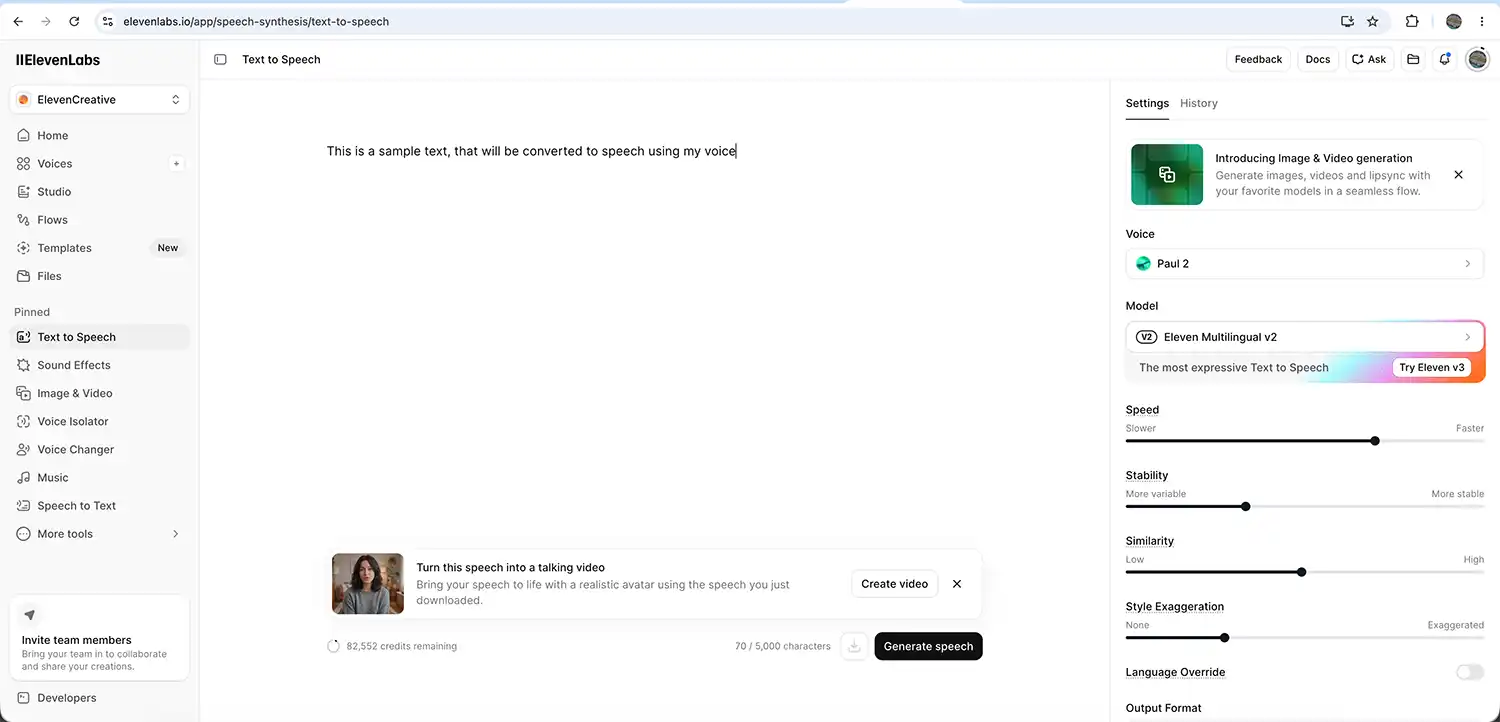
Users can type text into the editor and generate spoken audio using a range of realistic AI voices. These voices can vary in tone, accent, pacing, style, and emotional delivery.

For creators producing YouTube videos, explainer videos, TikToks, podcasts, or training material, this can save a huge amount of time.

Voice Cloning

Voice cloning is arguably the standout feature.

Users can train ElevenLabs using recordings of their own voice to create a custom AI voice model. Once trained, the platform can generate narration that sounds remarkably similar to the original speaker.

This is the feature I personally use the most.

Rather than using a completely artificial voice, I trained ElevenLabs using samples of my own voice. This allows me to type scripts while still keeping narration that sounds natural and personal to my videos.

elevenlabs text to voice dashboard

Multilingual Dubbing

ElevenLabs also offers AI dubbing and translation tools.

This allows creators and businesses to translate spoken content into multiple languages while maintaining much of the original tone and delivery style.

For larger YouTube channels or businesses with international audiences, this could become an extremely valuable tool.

AI Audio Tools

The company has also expanded into additional AI audio services, including conversational AI and audio generation features.

While most creators will likely focus on the narration side of the platform, it’s clear ElevenLabs is positioning itself as a much broader AI audio company.

Why Content Creators Are Using ElevenLabs

For many creators, producing voiceovers can be one of the slowest and most frustrating parts of video production.

Even when you know exactly what you want to say, recording narration perfectly can take far longer than expected.

Background noise, microphone setup, pacing issues, vocal fatigue, pronunciation mistakes, and repeated retakes can all slow the process down considerably.

This is one reason why AI narration tools are becoming increasingly popular.

In my own case, I occasionally stutter on certain words or get stuck repeating sentences multiple times trying to get the delivery right. The more takes I do, the worse it sometimes becomes.

Using ElevenLabs has genuinely helped reduce that frustration.

I trained the system using my own voice, so now I can type my narration into the platform and generate a voiceover that sounds like me. It keeps the tone and personality of my own voice while removing much of the stress involved with recording multiple takes.

For reflective or cinematic-style YouTube videos, I’ve found this workflow particularly useful.

How I Use ElevenLabs in My Own Workflow

My process is fairly straightforward.

Once I’ve edited together the visuals for a video, I’ll usually write the narration afterwards so the pacing matches the footage.

I then paste the script into ElevenLabs and generate the voiceover using my trained voice model.

Most of the time, the results are genuinely impressive.

Occasionally certain words may sound slightly robotic or unnatural, but I’ve found this is usually easy to fix by regenerating the line or slightly adjusting punctuation and sentence structure.

Shorter, conversational sentences tend to sound more natural than overly formal writing.

For me, the platform works best when I write exactly how I would normally speak in conversation.

The end result often sounds smoother and more relaxed than if I had spent an hour repeatedly re-recording narration late at night.

Why ElevenLabs Makes Sense for Small Creators

One reason I think ElevenLabs is particularly useful is because many small creators are handling every aspect of production themselves.

Filming, editing, thumbnails, SEO, blogging, colour grading, music licensing, and social media all take time.

Voiceovers can easily become another bottleneck.

Large creators often have dedicated audio setups, editors, or voice talent available. Smaller creators typically do not.

That’s why tools that streamline production can make a genuine difference.

Rather than spending excessive time fighting technical hurdles, creators can focus more energy on storytelling, creativity, and producing better content overall.

AI Voiceovers and Authenticity

Some creators understandably worry that AI narration removes authenticity from content.

Personally, I think it depends entirely on how the technology is used.

If you are using your own trained voice model ethically and transparently, I don’t see it as fundamentally different from using editing software, colour grading plugins, or AI-assisted noise reduction.

In my own videos, the narration still sounds like me because it is based on my own voice recordings.

The AI is simply helping improve efficiency and consistency.

SEO and Content Creation Benefits

Interestingly, tools like ElevenLabs may also indirectly help with SEO and audience growth.

Consistent uploads are important for platforms like YouTube and blogs, and reducing production friction can help creators publish content more regularly.

Additionally, clearer narration can improve viewer retention and accessibility.

Creators can also repurpose written blog content into spoken narration more easily, helping turn articles into videos, podcasts, or social media clips.

For businesses and website owners, this opens up opportunities for:

  • AI voiceovers for landing pages
  • Narrated tutorials
  • Product explainers
  • Accessibility improvements
  • Social media content
  • Podcast creation
  • Training videos

Is ElevenLabs Worth It?

For many creators, I think the answer is yes.

Like any AI tool, it is not perfect. Occasionally speech generation can sound slightly artificial, and some editing or regeneration may still be needed.

However, the quality is already remarkably good, and for creators who regularly produce narration-heavy content, the time savings alone can make it worthwhile.

The platform feels especially valuable for creators who:

  • Struggle with voice recording confidence
  • Stutter or trip over words
  • Produce regular narration-heavy videos
  • Want more polished voiceovers
  • Need multilingual content
  • Work alone without production teams

Final Thoughts

AI tools are becoming increasingly common within creative industries, and voice generation is likely to become a standard part of content production over the next few years.

For me personally, ElevenLabs has become a genuinely useful creative tool rather than a gimmick.

It helps reduce frustration, speeds up production, and allows me to focus more on storytelling and visual creativity instead of endlessly repeating voiceover takes.

While it occasionally produces slightly robotic delivery, regenerating the line usually resolves the issue quickly.

For YouTubers, podcasters, filmmakers, bloggers, and online businesses looking to improve narration quality or streamline production workflows, ElevenLabs is absolutely worth exploring — particularly if you create content regularly and value efficiency without losing personality. If you want to try Elevenlabs try my affliate link here

Frequently asked questions

What is ElevenLabs?

ElevenLabs is an AI voice generation platform that specialises in realistic text-to-speech, voice cloning, AI narration, and multilingual dubbing. It allows creators and businesses to generate natural-sounding voiceovers from typed text.

Is ElevenLabs good for YouTube creators?

Yes. ElevenLabs is particularly useful for YouTubers who create narration-heavy videos, tutorials, documentaries, podcasts, or cinematic content. It can help save time while producing professional-sounding voiceovers.

Can ElevenLabs clone your own voice?

Yes. ElevenLabs allows users to train a custom AI voice model using recordings of their own voice. Once trained, the platform can generate narration that sounds remarkably similar to the original speaker.

How accurate is ElevenLabs voice cloning?

In many cases, the voice cloning is surprisingly realistic. Tone, pacing, and speech patterns can sound very natural, although occasional robotic phrases may still occur. Regenerating the line or adjusting punctuation often improves the result significantly.

Why do content creators use ElevenLabs?

Content creators use ElevenLabs because it can:

  • Reduce voiceover recording time
  • Improve narration consistency
  • Help creators who struggle with repeated takes
  • Speed up video production workflows
  • Create professional AI-generated narration
  • Support multilingual content creation
Does ElevenLabs sound robotic?

Most of the time, ElevenLabs sounds impressively natural compared to older text-to-speech software. Occasionally certain words or phrases may sound slightly artificial, but regenerating the audio or changing sentence structure usually fixes this.

Can ElevenLabs help if you struggle recording voiceovers?

Yes. This is one reason many creators use it. If you struggle with stuttering, pronunciation, confidence, background noise, or vocal fatigue, ElevenLabs can make narration production much easier while still keeping a natural-sounding voice.

Is ElevenLabs better than traditional text-to-speech software?

In terms of realism and emotional delivery, many creators feel ElevenLabs is significantly more advanced than traditional robotic text-to-speech systems. Its natural pacing and voice quality are among the reasons it has become so popular.

Can businesses use ElevenLabs?

Yes. Businesses can use ElevenLabs for:

  • Website voiceovers
  • Product explainers
  • Online courses
  • Social media content
  • Customer support systems
  • Training videos
  • Podcast production
  • Accessibility improvements
Is ElevenLabs worth paying for?

For creators or businesses producing regular voiceover content, many people will likely find it worthwhile due to the time savings and audio quality. The value depends on how frequently you create narrated content.

Does ElevenLabs support multiple languages?

Yes. ElevenLabs includes multilingual voice generation and dubbing tools, making it useful for creators and businesses wanting to reach international audiences.

How do I get more natural results in ElevenLabs?

A few simple things can help:

  • Write conversationally
  • Use shorter sentences
  • Add commas and pauses naturally
  • Regenerate awkward lines
  • Avoid overly formal wording

Typing how you genuinely speak often produces the most realistic narration.

Can ElevenLabs be used for podcasts?

Yes. Many creators use ElevenLabs for podcast intros, narration segments, storytelling podcasts, educational content, and scripted productions.

Is ElevenLabs useful for solo creators?

Absolutely. Solo creators often handle filming, editing, thumbnails, SEO, blogging, and social media themselves. ElevenLabs can reduce one major production bottleneck by simplifying the voiceover process.